














Cultivating Belonging
 For most of my life, I have been intrigued by the question of what it means to belong to the land. Is belonging determined by where we are born, by our ancestry, by the culture that raises us? Or is it something that develops through relationship?
This question has become increasingly important to me as I reflect on the meaning of Indigeneity. One academic definition I resonate with says that Indigenous “refers to people and communities with longstanding and/or continuous connection to the land, whose cultures and spiritual practices are informed by and tied to the land.”
Today, it seems ever clearer how vital that connection to the land is: knowing how to work with nature and flow with it. We all know about the catastrophic consequences of forgetting or ignoring this relationship: extreme weather, degradation of the soil, loss of biodiversity, and what many scientists describe as the sixth mass extinction.
I feel that when we look broadly, with the eyes of the heart rather than through the lens of shortsightedness and greed, we can recognize that the “civilized” world has much to relearn from Indigenous societies. Perhaps most importantly, we need to remember how to live in reciprocity: not taking more than the Earth can offer, and finding ways to replenish and restore what we harvest.
At the same time, I do not romanticize Indigenous communities. Like any human society, they have their own complexities, wounds, and contradictions, which have at times given rise to internal conflict and even warfare between neighboring peoples.
My own journey with these questions began in Chile. As a child, I felt part of the valley and mountains where I grew up. There was never much doubt about belonging to my birthplace or to the society around me in Santiago.
Later, in my youth, as I learned more about the original peoples of Chile, I began pondering the diversity of my own roots. For the first time, I felt somewhat split in two and became curious about my European ancestry and what it meant to belong to a land shaped by so many different histories.
At twenty-one, I landed in the hippie scene of California and, strangely enough, I had never felt more at home. For many years after that, I lived as if I were simply a native of planet Earth. Home was wherever my heart was.
This changed in my early thirties, when I found myself in deep emotional distress and suddenly longed for “my land and my people.” I returned to Chile and recognized, in a much more visceral way, the bond I had with the land that had birthed me. It felt almost like an umbilical cord pulling me home.
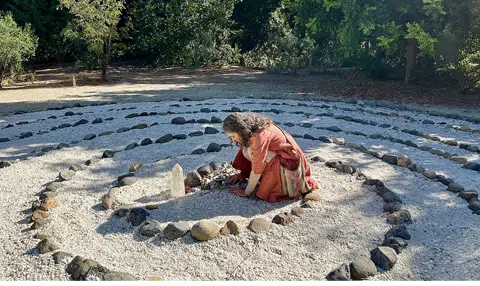
That sense of belonging deepened even further when I began working with the land itself. I became a caretaker of sixty acres, co-creating with the local community, with the seasons, the soil, the water, the trees, and the animals.
Over time, I began to understand that belonging to a place is not only about where we were born or ancestry. It is also about relationship. It is about learning to listen to a land, to care for it, to receive from it without simply taking, and to give something back.
Perhaps this is where my understanding of Indigeneity becomes most personal. I recognize something deeply true in the Indigenous understanding that land is not merely property or a resource. It is part of who we are. And the more I work with the land, the more I feel that belonging is something we inherit, but also something we cultivate and practice—through reciprocity, responsibility, gratitude, and care.
What has been your experience of belonging? Does it have to do with ancestry, community, relationship with the land, or something else?
With love,
Marcela Lobos
PS. Please share your thoughts. I love reading your comments and feeling the sense of community.